
Ideas for furnishing the TV wall: measurements, solutions, and design proposals
When furnishing the living room, one of the "zones" you often face, more than expected, is the TV wall.
The living room is the most lived-in room of the house, the one where everything that really matters is concentrated: your favorite CD collection, those books you wanted to read for a long time, the tablecloths your mother gave you.
Apart from cherished items, it is the space that tells who you are, and for this reason it deserves to be designed with care.
A spacious and storage-friendly piece of furniture is a necessity for many of us.
Yet, when thinking about furniture arrangement, doubts arise. Which furniture should I choose? Low or tall? Where do I put the TV? Shelves or a bookcase? How much space do I really have? Questions multiply and compromises, inevitably, too.
If you are here, you are probably trying to make sense of all this and you are in the right place.
To answer these questions, we have identified 5 approaches to furnishing the TV wall in your living room, suitable for different styles, spaces, and ways of living the living room. Before getting to the solutions, however, there is something worth understanding very well: where to start.
How to furnish the TV wall: where to start
Furnishing the TV wall is not just an aesthetic matter. It is first and foremost a design issue and some considerations, if not made at the right time, can become difficult to fix later.
Evaluate the space (first of all)
The distance between the sofa and the TV wall is not a detail: it is the parameter that determines the right size of the television. A screen that is too large in a small space strains the eyes; one that is too small in a large room loses impact.
The table with ideal distances between TV and sofa
As a general rule, the ideal viewing distance is about 1.5 times the screen diagonal, but here is a quick reference table.
|
TV size in inches |
Recommended minimum distance |
Ideal distance |
|
40" |
150 cm |
170 cm |
|
50" |
180 cm |
210 cm |
|
55" |
200 cm |
230 cm |
|
65" |
240 cm |
270 cm |
|
75" |
280 cm |
320 cm |
This assessment should be made before buying furniture and a TV (ideally during the room design phase, when you still have full freedom of choice).
Is the TV only visible from the sofa?
Another question to ask in advance: should the TV be visible also from the dining table or kitchen island? If yes, the orientation and installation height change. This also needs to be decided during the design phase: once the systems are installed and the walls painted, moving everything becomes a challenge.
How much should the TV wall be the protagonist?
Here a true aesthetic choice comes into play. The TV wall can be the main focal point of the living room, the first thing you notice when entering, or it can blend more discreetly into the room.
In general, the TV should never be the real protagonist. Not because it’s not important, but because when off it’s simply a black rectangle.
It inevitably contrasts with any wall, any color, any composition. It cannot be the center of attention.
The trick is to design the wall so that the eye falls on the composition as a whole, on the cabinet, the objects, the materials, the colors, and not on the television. This is done by blending the TV into the whole: coloring the wall, using wallpaper, playing with materials.
How? We’ll show you in detail later.
TV hung or placed? The question everyone asks
It’s the first question that comes to mind, and the answer is always the same: it depends.
But it depends on what, exactly?
Hanging the TV on the wall offers a compositional advantage that is often underestimated: that empty space between the screen and the cabinet below creates breathing room, lightness, airiness.
The composition looks more contemporary, the living room visually tidier.
Placing it on a cabinet can work well especially if the TV is small or if you only watch it from the sofa.

The unwritten rule? The bigger the TV, the better to hang it. The smaller the space, the more the low cabinet gains points in versatility and warmth.
The 3 solutions to furnish the TV wall
Modular system
The traditional wall unit made up of cabinets of various sizes is often the first thing that comes to mind, but the result is too often cold, impersonal, and has an anonymous and cluttered appearance.

Our favorite alternative is the modular system: a combination of closed doors, drawers, and open shelves that balances storage and personality.
The doors hide what shouldn’t be seen (set-top boxes, cables, forgotten DVDs); the shelves around the TV become the space where you express who you are: books, objects, plants, small collections.
The result is a wall that holds a lot, decorates, and tells a story. That’s exactly what makes the difference.
Low sideboard as TV cabinet
The low sideboard is the ideal solution for most living rooms. Well-proportioned, versatile, suitable even for smaller spaces, and able to give the room breathing space without sacrificing storage.
It’s also the piece of furniture where styling shines best: a vase, a tray with candles, some books, a plant, a frame.
These are the details, carefully crafted and intentional, that turn a piece of furniture into a corner of your home that speaks about you.

That’s why we created Urbana: a TV cabinet designed to be as functional as it is beautiful, available in a wide range of colors and finishes to suit every project, style, and home.
Sideboard, wall-mounted TV, and asymmetric shelves
The combination of a wall-mounted TV and side shelves is an interesting and often underestimated solution.
It works particularly well in one specific case: when the TV is off-center on the wall. Instead of forcing it to the center, place it on one side and balance the composition with shelves or bookcases on the other.
The result is dynamic and interesting.

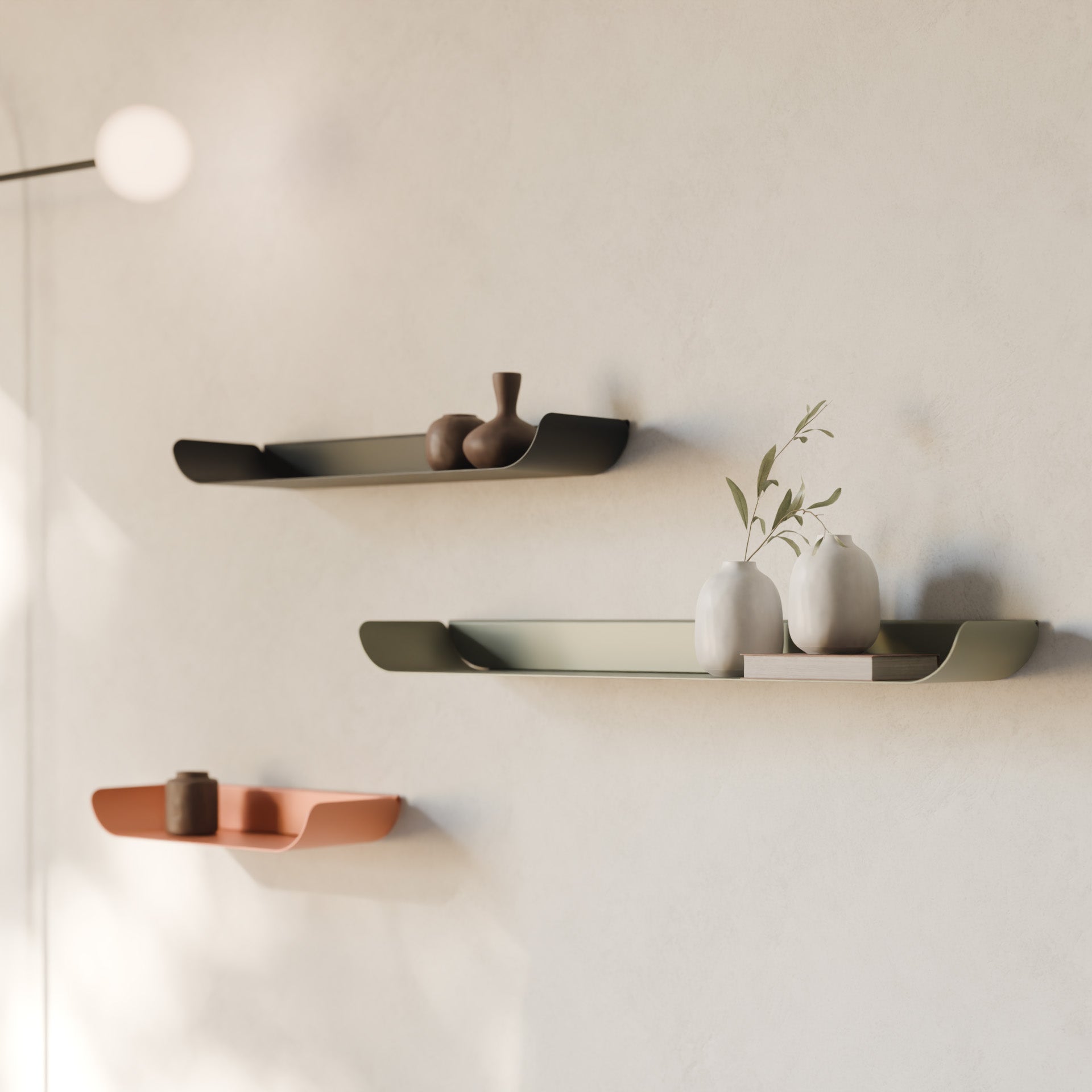
Lido Sideboard and Alveo Shelves
If you are considering this solution, also keep it in mind as an alternative to the modular system: with a low cabinet and a few well-placed shelves, you get a similar effect but lighter and easier to reconfigure over time.
Doubts and Frequently Asked Questions about the TV Wall
If you’re designing your TV wall, we’re sure there are some questions you just can’t get out of your head.
What size should the TV furniture be?
A practical question that often doesn’t get enough attention: the furniture should be at least 40 cm wider than the width of the TV to give proportion to the composition.
Going too low creates a very annoying imbalance.

Can I make the TV wall the focal point even in a small living room?
Absolutely yes. Often it’s in the most compact living rooms that the right choices make the biggest difference. In small spaces, low furniture is your best ally: it doesn’t visually crush the room, leaves the walls free, and lends itself to light but effective styling.
In small living rooms, a modular system often proves to be the best solution: it uses the wall vertically, providing storage space but also a sense of lightness, especially when the modules are suspended..
Furniture with doors or open?
It depends on how many things you need to store and how much you like to keep things tidy. Doors hide everything and maintain a minimalist look; open compartments allow more expressive freedom but require more care.
The mixed solution made up of closed compartments and shelves is often the most practical and the one that gives the composition the most character.
|
A note close to our hearts: the furniture you see in these images is made in Italy, on request, in small series. You won’t find them in a showroom with dozens of identical pieces waiting to be sold. Each piece is made when ordered, which means less waste, more care, and an object truly designed to last. For us, sustainability starts here. |
How to decorate the TV wall: style tips
Going back to what we mentioned at the beginning: the TV alone is not enough.
It’s the composition around that does the real work. Here are the combinations that work best.
Wallpaper + low furniture
One of the most effective combinations. Choose a pattern with character, in line with your style (geometric, botanical, textured) and pair it with a well-crafted low piece of furniture. The eye spreads across the entire wall, the TV stops being the center and becomes part of something bigger.
Modular system + colored wall
If you choose a modular system, consider painting the wall with a bold color, not necessarily different from the rest of the room, but strong enough to create depth. Side walls can also participate, especially if you work with a consistent palette throughout the living area.
Shelves and personal items
The objects around the TV are how your home stops looking like a catalog. A book read three times, a souvenir from a trip, a small plant: these details mean everything in terms of the space’s identity.
Make shelves beautiful with:
-
Spacious organizers for small items, in the colors you prefer and that best suit your room’s palette;
-
Designer bookends, for neat and impeccable rows;
- Colored frames to highlight your best memories.
The Hiro color range, wide and designed to meet different tastes and projects, is made for this: to let you choose furniture that is truly yours, not a standard solution adapted to your space.
Order your color samples here
Ideas to decorate the TV wall: your reminder
-
Start from the sofa-TV distance to choose the right screen size. Do this before buying anything.
-
Think of the TV as part of a composition, not the star: your goal is for the eye to focus on the wall as a whole.
-
Hang or place? Wall-mounted TV for a more airy look; TV on furniture only if the screen is small.
-
The modular system is the most versatile solution for most living rooms, styling included.
- The low cabinet and shelves combo next to the TV is perfect when the TV is off-center on the wall.
-
Color the wall, use wallpaper, add personal items: these are the details that make a room a place where its inhabitants are recognized.
- Choose TV furniture made to last, carefully crafted, Made in Italy: quality you can see and feel over time.
Discover Hiro solutions for your TV wall