

You walk around your home and feel like something is missing. All the furniture is there, but those bare walls seem to be begging you to decorate them.
But how? Shelves, paintings, family photos, or perhaps a splash of color?
In this guide, we'll share practical guidelines, proportions, ideas to copy, and a few concrete examples, so you can transform those empty surfaces into one of the most beautiful features of your home.
Decorating walls
Walls aren't just the shell of an interior design project: they're the largest surfaces we actually see at eye level, much more so than floors or ceilings.
For this reason, they deserve the same care you give to choosing a sofa or a table.
Decorating walls doesn't necessarily mean painting them. There are far more possibilities than you might think: paintings, mirrors, shelves, functional objects that become sculptural, wallpaper, textiles...
One rule always applies, whatever solution you choose: respect the height and proportions of objects in relation to the wall and the furniture below.
It's what makes the difference between a wall that "works" and one that's just "filled."
Decorating walls with paint
We won't go over all the possible paint variations, but it's worth mentioning a few interesting ideas for those who don't want to paint the entire wall.
Two-tone walls, painted arches, and geometric shapes are perfect for anyone who wants to add just a touch of color or create a play of volume, highlighting an architectural feature or a piece of furniture.
You can use a contrasting color on a pillar or column, paint the inside of a passageway arch instead of the outer wall, or draw an arch motif directly on the wall, even where no real arch exists.
Inside a painted arch, for example, you can place a small side table like Tiziano, topped with the Absi lamp, or three picture frames with photos arranged one above the other. You can also define an area with a different function from the rest: for example, in a living room entryway, you can group a console table and mirror in front of a block of color. This way, the entryway will look visually separate, without actually being so.

This way, you don’t just enhance the wall: you create a small focal point, perfect for a hallway, an entryway, or a landing.
The great thing about this solution is that you can make a big visual impact on a small surface, often with a DIY project.
It’s worth daring to use color, especially on small walls.
Have you already picked the right spot? Discover the College console table and the Odelia mirror for your entryway.
If color isn’t enough, or if you’d rather start with an object than a brushstroke, there are equally striking options.
Designer wall decorations: when functional objects become art
Paintings aren’t the only option. Mirrors, textured wallpaper, and small hanging sculptures can also take center stage on a wall.
A round mirror, for example, placed on the far wall of a colorful hallway, creates depth and becomes a striking focal point, while also bringing more light into the space.
Among the options that add dimension are also small sculptures to hang on the wall, an interesting alternative to traditional paintings.
Looking at it from another perspective, an object doesn’t have to be decorative to be beautiful: a functional object can also have sculptural qualities.

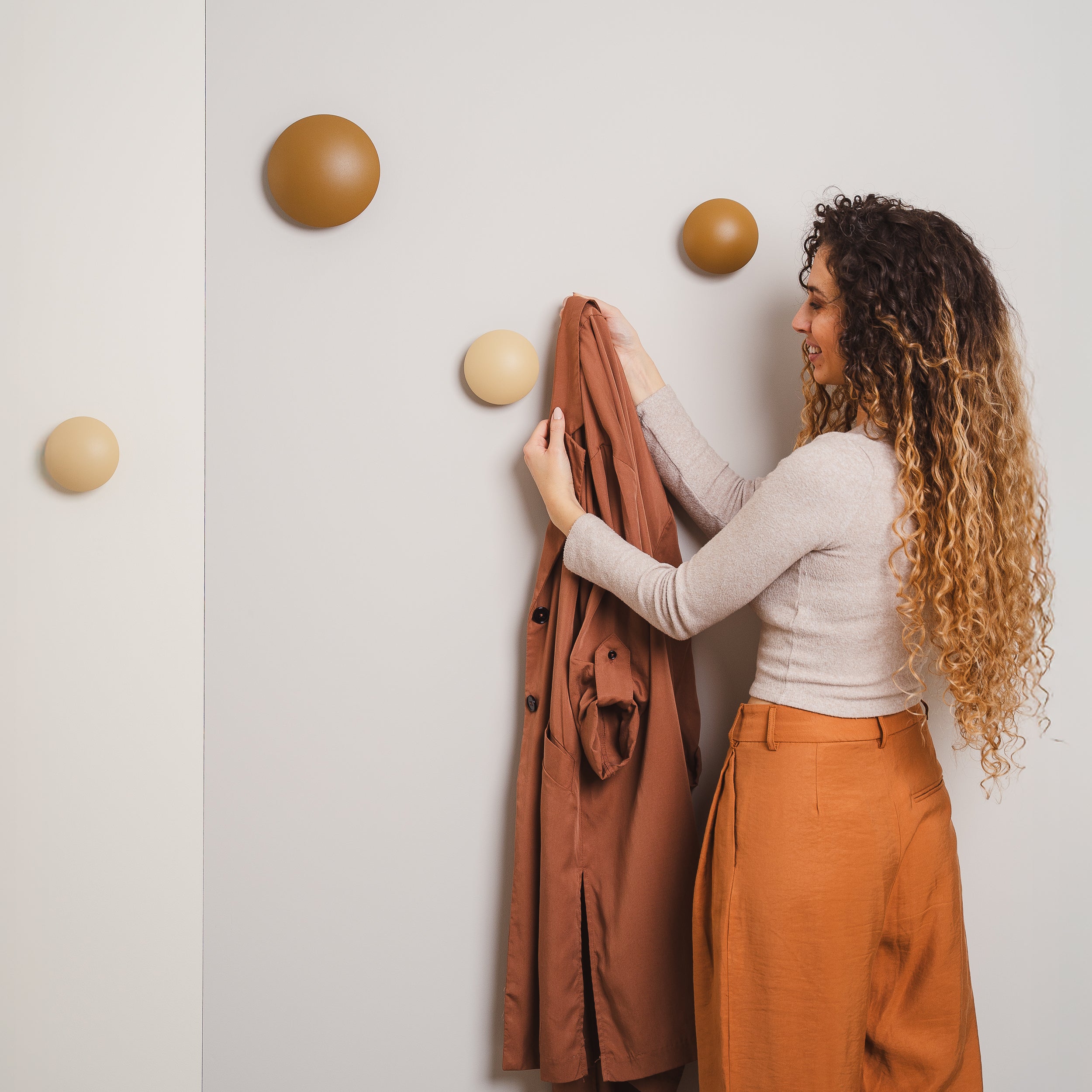
Take Waldo, the three-hook wall-mounted coat rack in painted steel. With its simple design, it already looks like a small sculptural composition and fits naturally in an entryway.

Coat racks, shelves with unusual shapes, and all kinds of everyday objects (like the trivets in the photo above), when carefully chosen, can be just as decorative as a work of art or an ornament.
Whatever you choose, paint or an object, the result always depends on the same basic criteria. Let’s look at them one by one.
How to decorate your walls? The golden rules to follow
Deciding how to decorate your walls, rather than what to put on them, is actually the most important question of all. Here are five criteria to guide any choice.
1. Not every wall needs to be noticeably decorated. There’s no need to fill every surface.
For example, you can leave these bare:
- walls less than 50 cm wide,
- the small sections of wall beside the window (it’s better to use a wider curtain than to hang small objects),
- the inner walls of an opening between two rooms.
In interior design, empty space matters as much as, if not more than, filled space: we need to accept that some walls can simply be left as they are.
2. Cohesion in decorations. Choosing decorations requires a certain degree of cohesion, but that doesn’t mean they all have to be the same.
Coherence can come from combining colors, repeating a palette, or using a particular color as a thread that ties the rooms together.
The mix of styles also contributes to the personality of a home: rustic and minimalist elements, vintage and modern pieces, travel mementos and designer items. Everyone decides on their own mix based on personal taste.
3. Proportions and distances between elements. You may have the most beautiful picture in the world, but if you hang it on a wall that’s too small or too large to show it off, it becomes a flaw rather than an asset.
4. Creating a focal point: visual hierarchy. Every room should have one wall that catches the eye more than the others. When you enter a room, ask yourself: What should I look at? What do I want to see first?
In the living room, for example, you can choose to highlight the TV wall or the fireplace wall: if they are on different walls, it’s best to decide which one to highlight, so they don’t compete with each other. The focal point could also be a large window with a special view, which you can orient the furniture toward.
The same technique can also help draw attention away from a flaw: you can highlight another wall with a striking decoration or a contrasting color, directing attention wherever you want.
Not every wall needs to be heavily decorated: there should be a hierarchy, with one feature wall and the others playing a supporting role.

A prime example is the TV wall: if you want it to become the focal point, choose a visually striking unit from the outset rather than gradually adding two or three small, different pieces of furniture and risking a cluttered look.
If the TV wall is your weak spot, fix it all at once: discover the Linnea system, which covers the entire wall.
5. How to choose the format based on the wall and the furniture below
If there’s a piece of furniture under the picture (a sofa, a sideboard), the picture or gallery wall should be at least two-thirds as wide as the furniture.
The gallery wall can also extend from ceiling to floor in a more eclectic arrangement, as long as it doesn’t run behind the furniture and there are at least 20 centimeters of clear space around it.
For a “floor-to-ceiling” arrangement, you can also extend beyond the boundaries of the furniture below, but the result should still feel considered and well-proportioned.
If the wall is empty, the gallery wall or picture can cover at least half or two-thirds of the wall’s surface, including vertically.
Once you’ve clarified the overall approach, it’s time to work out how to translate it into specific choices of materials and shapes.
How to choose shapes, materials, and finishes?
Throughout the home, the goal is to create cohesion by repeating materials thoughtfully. This applies to wall decorations, too.
- Wood: if you decide to repeat it, choose a finish (raw or finely finished wood?) and a reference color. You can also choose two different wood species to pair together.
- Metals: you can create cohesion with chrome metals, or with colored and painted metals that match the home’s palette.
- Glass: transparent throughout the home, or as a colorful accent in a few strategic spots.

When it comes to shapes, a highly impactful design choice is to choose between rounded shapes and sharp angles, then favor furniture with your chosen shape throughout the design.
Equally impactful is the repetition of a geometric shape, which can be achieved, for example, through lamps, knobs, coat hooks, or posters.
In a home with arched openings, you can echo this shape in side tables, magazine racks, and even shelves, creating cohesion and drawing focus to this feature.
Of all the possible decorations, pictures are the most classic, but a picture that’s poorly positioned doesn’t get noticed. Let’s explore basic placement rules and gallery wall ideas in the next section.
How to decorate walls with pictures?
Choosing where to position pictures involves considering their dimensions and shapes, combinations, and the size of the wall.
Symmetrical, grid, and asymmetrical arrangements
A symmetrical arrangement works well with pictures of the same size: two or three matching pieces, aligned horizontally or vertically, always keeping the same distance between each one.
A grid arrangement, for example four identical pictures arranged in two rows of two, also requires precise alignment: pictures of the same size should never be staggered.
An asymmetrical arrangement, on the other hand, works best with pictures of different sizes and creates a more dynamic result, while still maintaining a visual connection between the artwork and the furnishings below.
You can mark out an imaginary rectangle on the wall and place different pictures inside it, always leaving the same distance between each one.
An XXL picture or a gallery wall?
An XXL-sized picture is a particularly eye-catching option that can instantly create a refined, luxurious look.
You don't necessarily need a work of art: you can achieve an interesting result with just a simple frame and a piece of wallpaper inside it.
A gallery wall, on the other hand, is a more dynamic option, perfect for anyone who likes to change things up often or collects travel souvenirs. You can also include small sculptures and hanging souvenirs for an eclectic, personal arrangement.
Both options look great on a large wall that you want to turn into the room's focal point.
The key rule is always to respect the proportions of the arrangement in relation to the wall and its position.
How do you match colors, artwork, and frames in a gallery?
The choice depends on the style of the home: a contemporary, minimalist space calls for different choices than a more eclectic home.
For the artwork: it should share colors and/or a decorative style, and the images can tell something about you and your story.

There are several options for your frames.
- All matching, in the same color and finish, for a neat, minimalist result.
- Mix of neutrals and wood: white or beige frames paired with one or two wood tones repeated throughout.
- Mix with colorful accents: neutral or wood frames for about 70% of the gallery, and the remaining 30% with colorful frames.
Want to create your gallery wall without the hassle? Find all the Plico frames in one collection, ready to mix and match.
What can I put on the walls instead of a picture?
If pictures aren't quite your thing, or you simply want to try something different, there are plenty of alternatives.

- A round or sculptural mirror, which not only decorates but also brings light and depth to the room.
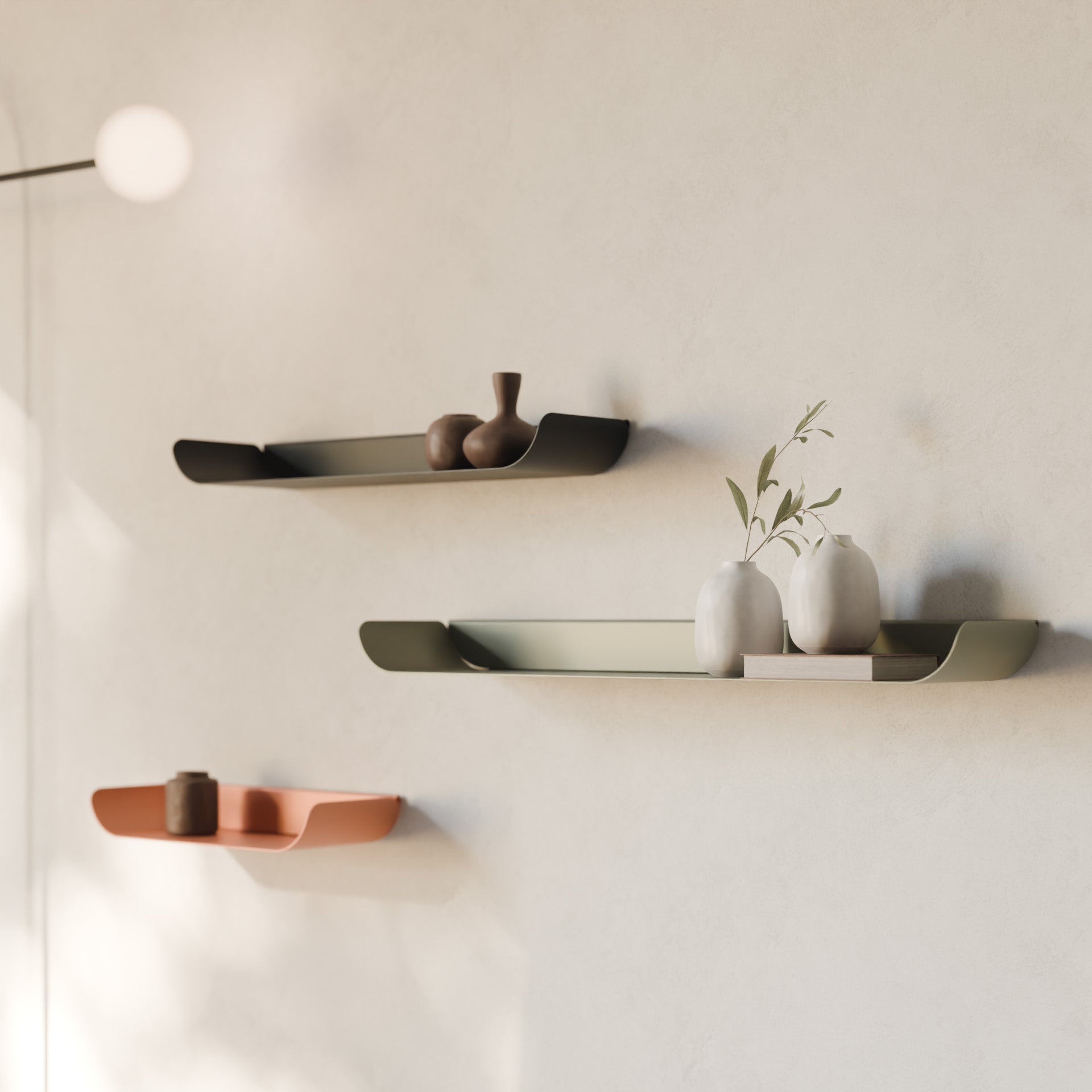
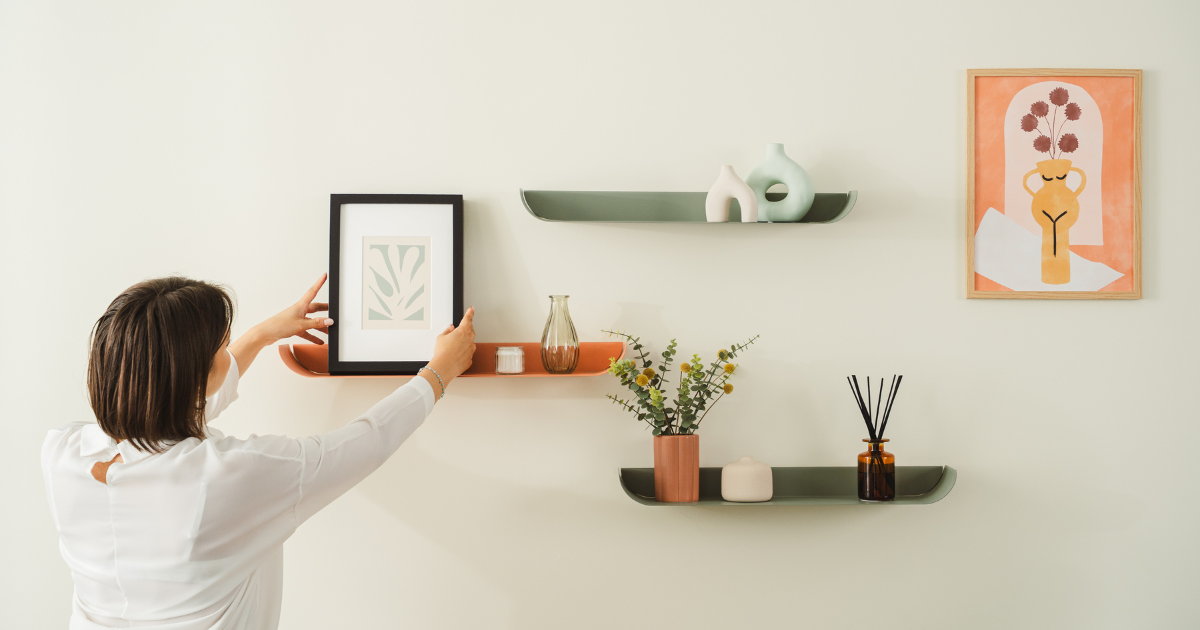
- A shelf with carefully chosen objects. A distinctive shelf can itself become the focal point, even with just a few objects on it. A shelf with carefully chosen objects. A distinctive shelf can itself become the focal point, even with just a few objects on it. Looks aren't everything: placement matters too. In our guide to how to arrange shelves, you'll find layouts that make them work well.
- A sculptural coat rack, combining function and decoration in one object.
-
Textured wallpaper, even on just one wall, for a bold effect without covering every surface in your home.
-
Textile art and tapestries, especially if you love eclectic style or want to soften the acoustics in a very reverberant room.
- A small personal collection, plates, souvenirs, hanging musical instruments: anything that tells your story works just as well when arranged using the same proportion guidelines as for pictures.
How do you decorate very high or low walls?
Before choosing how to fill a wall, it's helpful to consider its dimensions.
A wall is considered high if it's over 290 cm and low if it's under 250 cm. In between, at around 250 to 270 cm, the standard rules we've covered so far apply, with no need for special adjustments.
In either case, whether the wall is high or low, the basic principle stays the same: position the center of the decoration at eye level, ideally between 140 and 160 cm from the floor.
How do you decorate a low wall?
A low wall, under 250 cm, slightly changes the approach we've seen so far: there isn't much vertical space, so it's better to arrange things horizontally rather than vertically.
An elongated gallery wall, a single very long shelf, or a panoramic picture work better than a vertical arrangement or a full-height bookcase, which could make the room feel visually cramped.
How do you decorate a tall wall?
For a tall wall, you can choose a custom-designed solution, such as a bookcase or a substantial shelving unit, and fill it with objects arranged on the shelves. Alternatively, large-format artwork or striking wallpaper, perhaps limited to the feature wall, is enough to fill the height without spreading your efforts across a thousand small elements.
How should you distribute decorations across multiple levels?
If you choose a bookcase, the lower section can hold the visually heavier items, while the center section is a good place for your most beautiful objects, the ones you really want people to notice. The upper section should be a little lighter, since it’s the area people look at least often.
If you create a gallery wall, place the most representative pictures in the center of the arrangement and distribute the other elements around them, keeping everything cohesive.
When should you choose a single statement decoration?
When you find the right one (the one that truly represents you, is the perfect size, and has colors you love): it could be a work of art, a sculpture, or an object you brought back from a trip. It should be an important piece, but also in proportion to the wall: as a guide, aim for a width of about three-quarters or at least half the wall, and, if there’s no furniture below it, a proportionate height as well.
You don’t have to drill into the walls
You can also create a focal point with a beautiful, functional object, without having to hang anything. In an entryway with a tall wall, for example, a freestanding coat rack like Milo can enhance the wall behind it all on its own, perhaps painted in a complementary color.
This approach works particularly well with stone or brick walls, or walls with paneling: these surfaces are already beautiful in their own right, and you can enhance them simply by placing an element in a strategically chosen color in front of them.
Wall decorating, in a nutshell
Decorating the walls of your home isn’t about quantity, but about making thoughtful choices: respecting proportions, establishing a clear visual hierarchy, keeping materials cohesive and, above all, having the courage to leave empty what doesn’t need to be filled.

