

Contemporary homes are no longer fixed places. They change layout, function, and rhythm with a naturalness that was unthinkable just a few years ago.
A living room accommodates daily work, a wall that was once decorative becomes storage, an unused corner suddenly needs to find a new function.
It’s not just a matter of square meters but of continuous transformation of living.
In this scenario, modular furniture meets the need to adapt to change with versatility.
Modularity introduces a different way of designing: no longer definitive compositions, but open, flexible systems ready to transform along with daily life.
What is modular furniture?
Modular furniture consists of independent elements designed to be combined in variable configurations. Each module maintains its own functional identity but contributes to building a coherent, proportionate, and visually harmonious whole.
The difference compared to traditional furniture is substantial.
A “traditional” piece of furniture is created as a finished object: size, function, and shape remain unchanged.
A modular piece of furniture is part of a customizable configuration, among multiple compatible elements.
A modular system, on the other hand, remains open over time: it can expand, shrink, change arrangement, or take on new functions without losing aesthetic coherence.
This design freedom can easily solve even complex layout projects or irregular spaces.
Modularity is not just a practical solution: it is a design principle that puts the evolution of the home space at the center.
Why is modular furniture so in demand today?
The growing interest in modular furniture reflects a profound change in the way we live.
- Contemporary homes require smarter furniture rather than bulky pieces. Spaces are often limited, and every element must serve multiple functions without being visually intrusive.
- Added to this is greater housing mobility: frequent moves, rentals, and reorganizations make it less practical to invest in furniture that is hard to adapt.
This is how a more conscious idea of furnishing is born: furniture that does not belong to just one home but accompanies different phases of life, adapting to new contexts without losing identity. True nomadic furnishings, designed to last precisely because they can change shape, room, and function.
- A modular system can grow little by little. After years in which the home has taken on new roles – workplace, personal refuge, shared space – the need for environments capable of quickly transforming emerges.
Modular systems meet this need with a progressive logic: you can start with a few essential elements and expand the composition over time, spreading the investment and maintaining visual continuity.

Modular furniture: effective solutions
When talking about modular furniture, it refers to systems designed to build customized configurations through the union of multiple compatible elements. Modularity allows precise responses to the characteristics of the space, avoiding standardized solutions that often appear disproportionate or visually heavy.
Modularity can develop in different ways:
- for stacking of storage elements, often used for shoe rack modules, bookcases, or nightstands;
- for side-by-side arrangement: horizontal compositions are common, for example, for modular sofas or modular shelves.

Design examples: when a modular furnishing truly solves a space
The real strength of modular furnishings lies in their ability to solve complex home situations with lightness and design intelligence.
Here are some examples.
The modular shoe rack: when the entrance really doesn’t exist
Many contemporary homes do not have a defined entrance.
The door opens directly onto the living room or kitchen and there is no dedicated wall to organize welcoming functions. In these cases, a traditional shoe rack risks appearing as a poorly integrated block.

A minimal and compact modular shoe rack, installable either suspended or resting on the floor, completely changes the approach.
A suspended module or two stacked modules near the door can symbolically suggest the presence of the entrance without creating rigid separations.
The storage function integrates into the living area and becomes discreet.
The composition can be precisely calibrated by adding only the necessary modules.
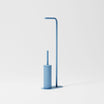
Discover Hiro modular shoe racks: compact and configurable solutions, perfect even in spaces without a defined entrance.
The modular wall shelf: a wall that becomes architecture
Among modular furnishings, wall systems are probably those with the greatest design potential.
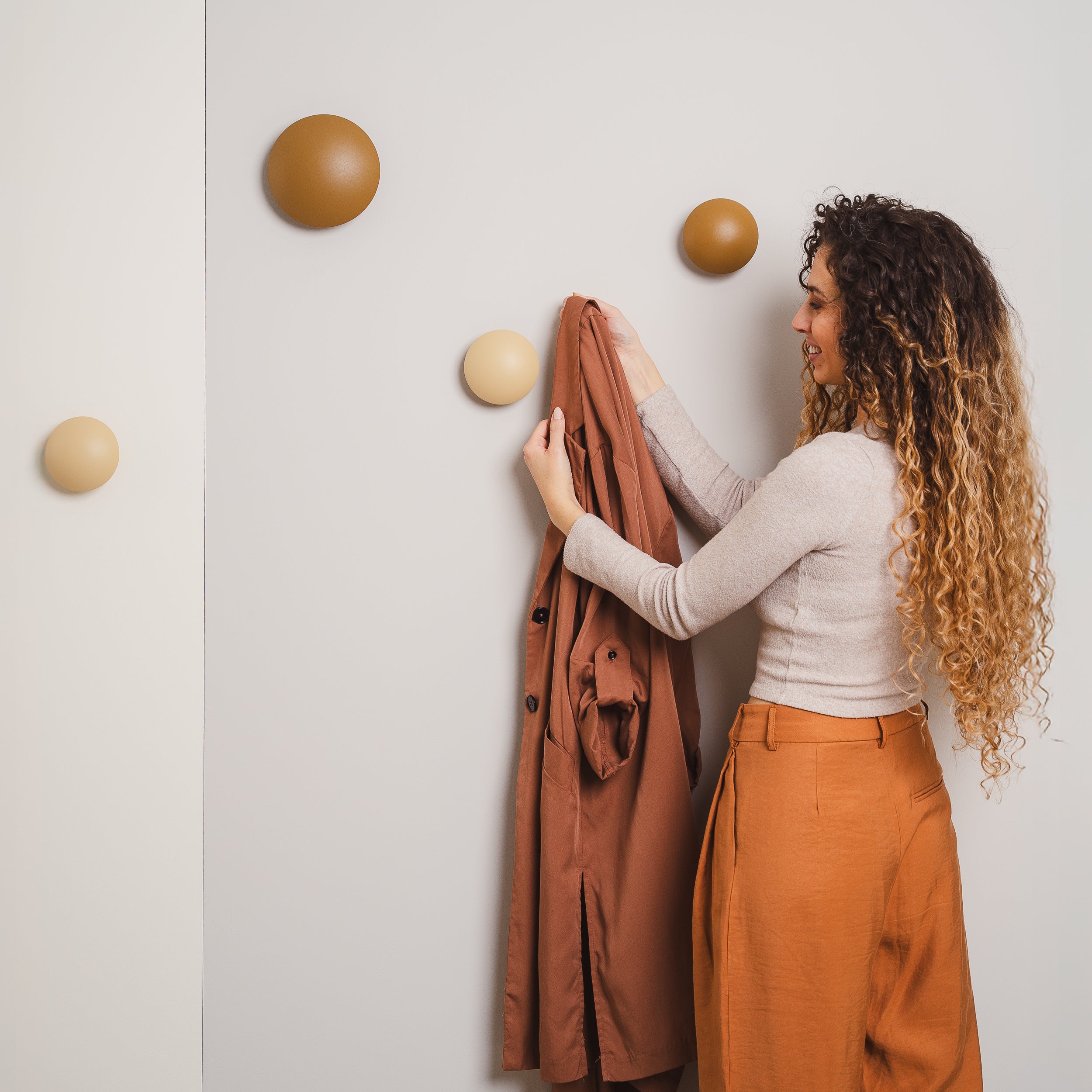
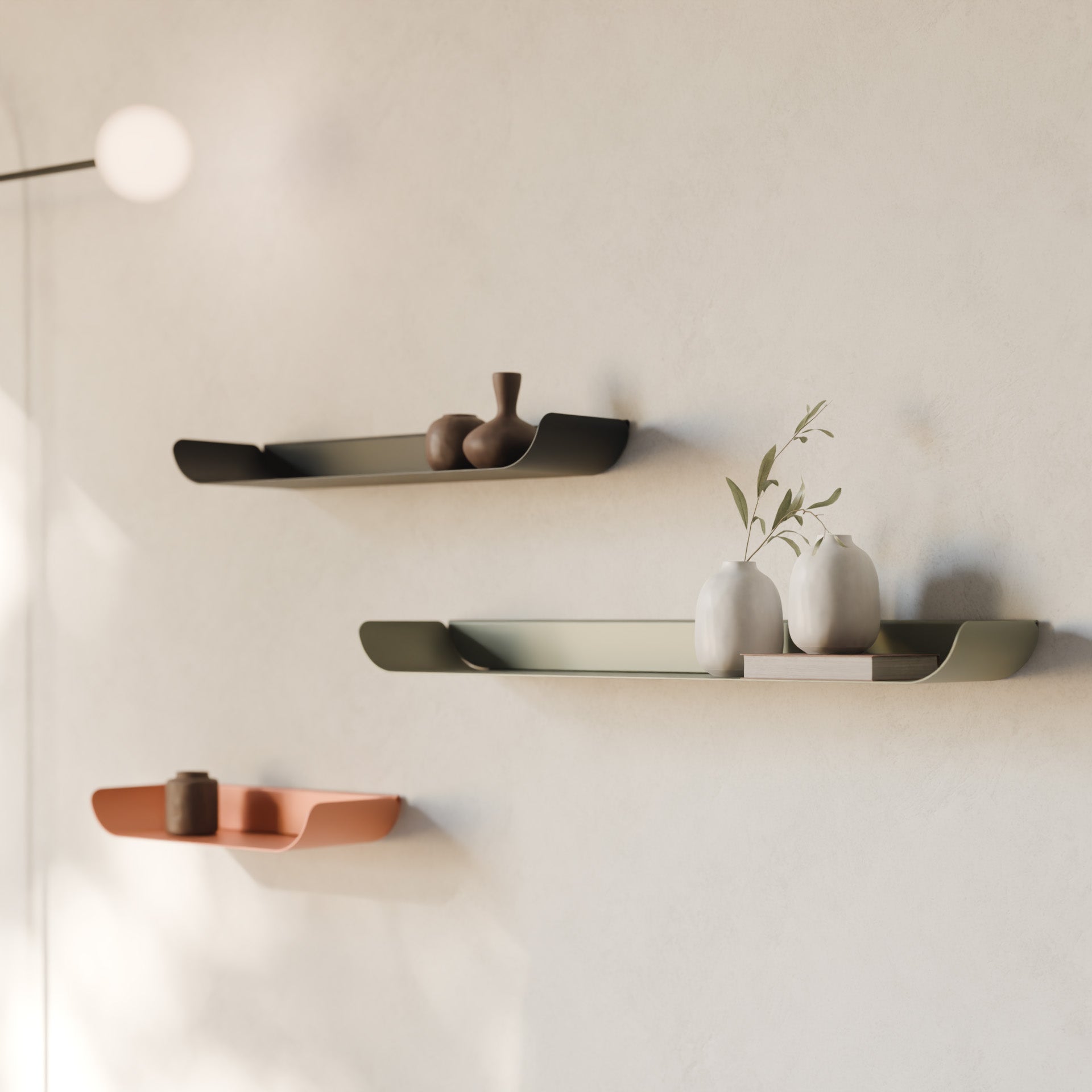
The combination of closed modules, shelves, desk surface, coat racks, and integrated supports allows building extremely versatile compositions.
A clear example is the TV wall, often dominated by a dark screen that disrupts the visual balance of the living room. By integrating the television within a composition, alternating solids and voids, open elements and closed storage, the visual weight is distributed and the TV stops being an isolated object.
The same system naturally solves another increasingly common need: creating a work area in small spaces.
An integrated desk module appears only where needed, interacts with shelves and storage units, and avoids the effect of an improvised workstation. The desk is born from the wall itself.
Moreover, modular systems allow building an open walk-in closet, visually much lighter than a traditional wardrobe.
Even long walls, often difficult to furnish without creating monotony, find balance thanks to modularity. The alternation between closed modules, shelves, and empty spaces introduces rhythm and movement and dresses the wall while adding storage space.
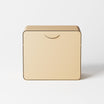
Design your wall with Hiro modular systems: combine shelves, storage units, and work surfaces in a single coherent and customizable composition.
The modular nightstand: small gestures that change the perception of the bedroom
The nightstand is one of the most underestimated elements in bedroom design, yet it can deeply influence the visual balance of the space.
In a attic bedroom, for example, the sloping wall often makes it difficult to use two identical nightstands.
Modular nightstands with stackable open compartments allow following the slant of the ceiling: two stacked modules on one side and a single element on the other create an intentionally asymmetrical but perfectly balanced composition.
The nightstand thus stops being an isolated object and becomes almost an architectural extension of the wall.

Modularity proves valuable even in the most dynamic bedrooms or in a studio apartment, where the space accommodates different functions. Reading, light work, small moments of relaxation.
Using two independent modules for the nightstand, one can stay next to the bed while the other easily moves to become a small side table near an armchair or desk. The furniture adapts to daily use.
Discover Hiro modular nightstands: flexible elements that adapt to irregular spaces and change function along with your needs.
Modular furniture: are they as sturdy as “fixed” furnishings?
Those new to modular furniture often worry it might seem temporary or less sturdy than traditional furnishings. There’s no universal answer, but precisely because this furniture is so versatile and practical, it’s important to choose materials carefully, so they accompany you for life.
Choosing well means considering modularity as a long-term investment: furniture meant to evolve with the space, maintaining balance and functionality even after many changes.
Modules made of painted steel ensure a strong and durable structure, especially suited to being reorganized over time without ever losing reliability.
Hiro furnishings are made in Italy, in small batches, avoiding overproduction and favoring a supply chain focused on construction quality.
|
What designers say: the real benefits of modular furniture
From a design perspective, modular systems are one of the most effective tools for creating transformable and versatile spaces.
They allow for a progressive evolution, where the space takes shape over time without requiring immediate final decisions. This flexibility lets you see how the home is truly lived in before completing the furnishing.
The advantages of modular furniture most appreciated by professionals are:
-
adaptability to irregular walls and complex spaces;
- possibility to reconfigure the setup without replacing everything;
-
precise optimization of the available space;
- longer lifespan thanks to the replacement of individual elements if they wear out over time.
Thanks to the ability to grow, reconfigure, and optimize every available centimeter, modular furniture allows you to create spaces that transform over time, following the evolution of your needs.