
Beautiful bookshelves, but how do you style them so they don’t always look messy or heavy?
If you see those shelves only as a base to fill with books, maybe you’re wasting an opportunity.
The bookshelf is a means through which you can exercise taste, memory and aesthetics.
A well-kept bookshelf is the perfect backdrop for your study, hallway or living room: it can become a starring piece.
Sure, if you choose a designer bookshelf you’re already ahead, but styling makes the difference: it can either completely dull it or enhance it to the fullest.
Here is the definitive guide to bookshelf styling.
Great principles for tasteful styling
Don’t know where to start to give your bookshelf or shelves a neat and stylish look?
We want to share with you the most important rules used by interior styling professionals, but don’t take them as written in stone: have fun experimenting, even breaking them, if you want.
Mix of books and objects: balance between function and beauty
You have a bookshelf to set up or tidy in front of you and you have two options:
if you filled it completely only with books, all aligned and dense, you would miss the chance to add a touch of personality and risk making each shelf look very heavy and cramped.
The second option is to display books by creating, for each shelf, a dynamic stage, pleasant to the eye and able, yes, to contain, but in great style.
How to do it? Just vary the content of each shelf. Not only books, but also cherished objects, art and beautiful containers.
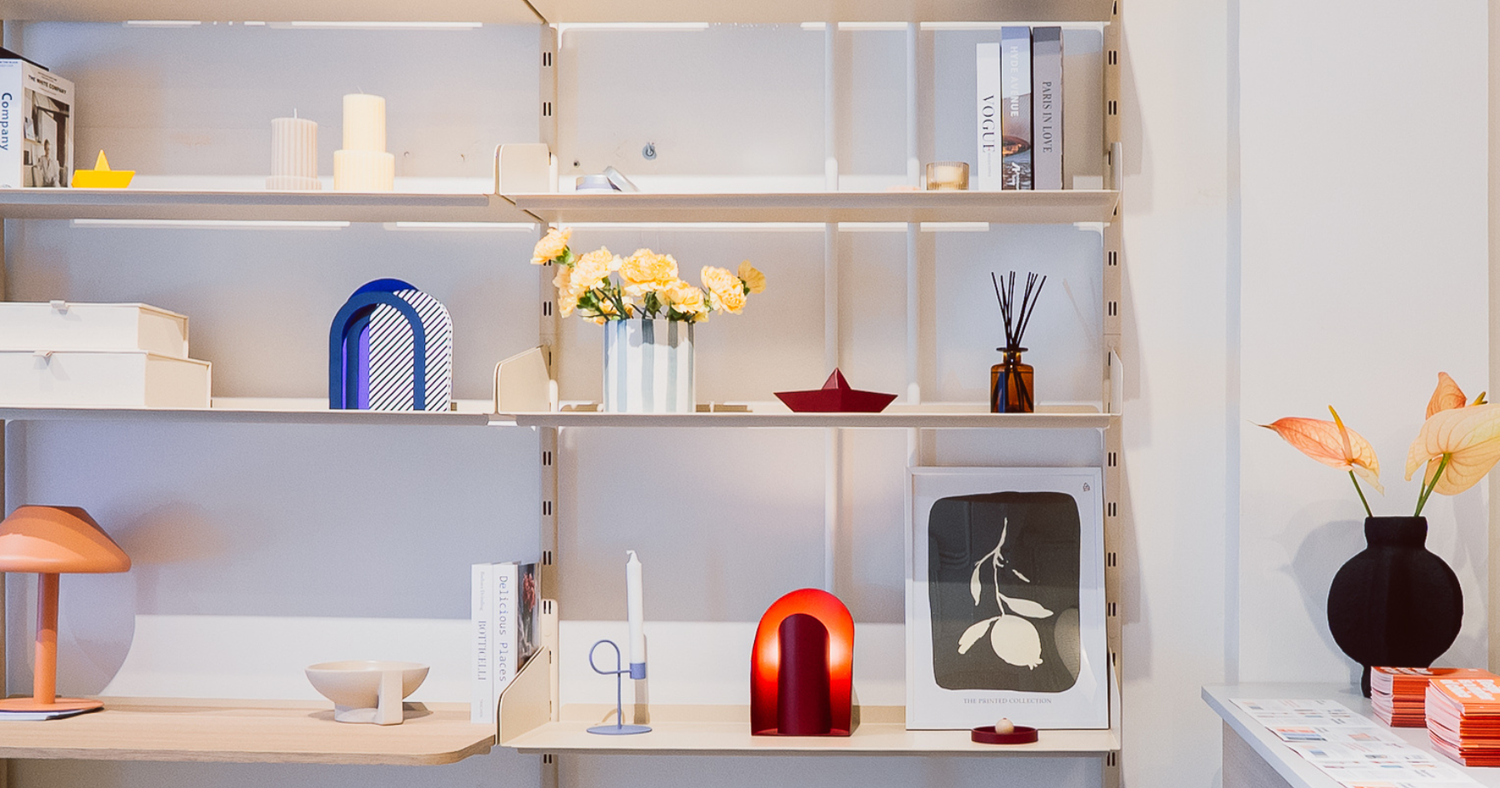
Alternate, on the shelves, stacks of books with objects like plants, pots, photographs, small sculptures. The ideal is to choose pieces with different materials and textures: ceramic, metal, glass or fabric.
Too many decorative objects risk making everything chaotic? Yes, balance is key: better to have few objects - but well chosen - empty spaces, color and material coherence.
Here are some ideas on which objects you could place on a bookshelf, besides, of course, books:
- cherished objects;
- small sculptures;
- decorative paperweights;
- candle holders;
- organizers and beautiful containers;
- small plants and pots with fresh, dried or preserved flowers;
- table lamps;
- incense holders or air fresheners;
- frames with photos, posters, and paintings.
Books in motion
Let's start with them: the protagonists.
How to position books and magazines on the bookshelf?
To make the setup dynamic you can, for example:
- create spots with a few books aligned vertically and other spots with a few books stacked horizontally;
- place a vertical stack and a horizontal stack next to each other, the latter supporting the former;
- place the larger books or those with the most beautiful covers “facing forward”, rather than sideways;
- in the same way you can place a stack of few books facing forward, held in place by a designer bookend;
- use one or two books stacked horizontally to make a low object taller, making a composition of objects more harmonious.
Is it better to sort books by color or by category?
Both options are fine: it depends on your habits and your flair.
Sorting by category is useful if you often consult the books; sorting by color creates a more graphic and eclectic visual appearance.
You don’t necessarily have to follow one method or the other.
You can also turn some books with the pages facing outward if you want to lighten the composition with white.
The rule of thirds
You have a long shelf or a shelf on a bookcase and you need to put something on it.
Where do you start? Where and at what distance to place objects on the bookshelf shelves?
A useful technique: mentally divide the shelf into thirds and place the key pieces at the intersection points.
On the shelf above, or below that you will set up later, you can choose to place objects corresponding to the empty spaces left on the first shelf.
This way you will have a balanced alternation of filled and empty spaces.

Create your vignettes
But let's get to the crucial point: the composition of vignettes.
What are vignettes in interior styling?
In styling language, “vignettes” are not drawings: they are small curated compositions of objects grouped together on the same shelf or surface.
What characterizes a vignette?
-
A main object (e.g. vase, plant, or sculpture).
- Support objects with different heights (e.g. book laid flat, candle holder, frame).
- A micro-story: each vignette conveys a mood, has a function, or expresses a piece of your personality.
The purpose of creating vignettes is to make the objects appear intentionally placed and not simply “randomly” set on a shelf.
The aesthetic advantages are really many and positively affect the personalization of the space and the enhancement, not only of the bookshelf but of the entire room.
- They create rhythm.
- They add depth.
- They keep it “tidy” without rigidity.
- They make the environment more refined without overfilling it.
The triangle technique
In practice, how to arrange and group objects on furniture and shelves?
Or rather, what should be considered? How should the objects to be grouped be, to look good together?
A very useful technique for arranging bookshelves, but also furniture surfaces, is the triangle technique.
- Choose three (or more) different objects by height, shape, and color.
- For each small group, choose a hook object, taller than the others, that immediately draws attention (a dominant object like a vase, a plant, or a painting) and arrange the other two to create a triangle: tall, medium, low.
- Books placed horizontally are great allies for adjusting heights.

Playing with heights, depth, and empty spaces
- We have already seen how useful it is to vary the heights: a tall object, a medium one, a low one, when placed together, make the composition dynamic.
-
Depth: do not align all objects in a row. Overlap, layer, place some objects forward and others backward.
You can also use a painting at the back and place books or small objects in front. This layering technique makes the composition meaningful and dynamic.
-
Empty space is as important as filled space, because it helps to give breathing room to the arrangement. Do not fill every inch. Leaving some free spots helps the eye to rest and better highlights what matters.
Palette and visual coherence (60-30-10 rule)
How to manage the colors to be included on the objects of the bookshelf?
Should the objects match the color of the walls or the color of the bookshelf?
Let's start with a broader discussion, which concerns not only the bookshelf but the entire room where it is located, where the choice of colors can follow the 60-30-10 rule.
That is: a main color, a secondary color, and an accent color.
Here are some tips for choosing accessories so they harmonize in the room.
-
Repeat the materials present in the room (or in the house, in general) on the objects. For example, is there a light wood piece of furniture in the room? You can add one or more light wood boxes or a container with light wood accents. Do you have furniture with glass doors? Add transparent glass vases.
-
Objects must be seen, not camouflaged. So, especially if the bookshelf is colorful, don’t choose all objects in the same color as the shelves.
-
If you have many colorful books, you can mostly play with materials and neutral colors. Additionally, you can add some element that repeats the room’s main color or a very scenic or contrasting element that brings the accent color into the room.
-
If you have objects the same color as the shelves and want to make them stand out, just create a visual break by placing a contrasting tray under these objects.
For example: if you have a bookshelf with white shelves and many white objects you want to display, you can place under some of them a vanilla-colored tray, to break up and prevent them from getting lost.
Can’t you ever find objects in different colors to choose from?
Take a look at the super colorful made in Italy pieces signed Hiro.
Shelf hierarchy
- The eye-level shelf becomes the stage: here place the most curated composition, with impactful objects like a neatly stacked pile of books, a vase with fresh flowers, or an interesting decorative element.
-
The lower shelves can be denser with books or “storage” contents (heavy books, boxes, containers).
- In the areas higher than where the gaze usually rests (or in less visible spots) use decorative pieces, vases, plants, or leave space: the light effect at the top creates balance.

Step-by-step bookshelf setup
Here’s how to proceed concretely, and easily, to transform your bookshelf.
-
Empty everything. Start from a clean shelf: this way you see what you have and what you want to show.
-
Select the “anchors”: books you want to keep visible, decorative objects, photos, plants, boxes, containers if needed for organization.
- Decide on a color and material palette, consistent with the rest of the room (great if you have a colorful bookshelf: you could use objects in neutral tones + a contrasting color accent).
-
Create compositions for each shelf: mix vertical and horizontal books, add 1–2 objects on each shelf as visual hooks and leave empty spaces to breathe.
- Use the triangle or rule of thirds: place key objects at the strong points of the visual space and create triangular shapes with them.
-
Various heights and depths: use horizontal books as pedestals, place objects behind and in front, play with plants or narrower and taller objects.
-
Balance from bottom to top: many books and containers at the bottom; decorative pieces and accents at mid-height or top; pay special attention to the shelf at eye level.
-
Strategic bookends: if you have books facing out with interesting covers, display them like works of art. Color and shape become part of the design.
-
Containers and boxes: useful for hiding small objects or keeping order, making the bookshelf beautiful but also functional.
-
Reassess and adjust: once finished, step back, observe and modify. If something seems to “weigh” too much, move it, remove an object or replace it with a lighter one.
Take your time. Setting up a bookshelf is not something to rush: it is a creative act. Every book, every object, every empty space tells something about you.
With the right approach even a simple bookshelf becomes an attractive object.
When the structure is carefully designed - like a made in Italy design shelf - the setup becomes the final, decisive touch: the one that transforms the furniture into a home, into an environment, into a story.